


The Email Warm-Up Myth: Why It Doesn't Work at Scale
For years, inbox warm-up has been positioned as the silver bullet for making cold email work. The theory sounds sensible enough. Gradually increase your sending volume over weeks or months, mimicking organic growth patterns, and email providers will reward you with better deliverability. Entire businesses have been built around this premise, offering automated warm-up services that promise to ease your domain into the good graces of Gmail, Outlook, and Yahoo.
But here’s the uncomfortable truth that most mailbox stacking services won’t tell you. Warm-up is largely theater. At scale, it’s not just ineffective, it’s expensive, time consuming, and a distraction from what actually matters.
The Seductive Logic of Warm-UP
The warm-up narrative goes like this. Email providers use sender reputation as a key factor in filtering decisions. A new domain or IP address has no reputation, so it’s viewed with suspicion. By starting small, maybe 50 emails on day one, 100 on day two, doubling gradually, you demonstrate that you’re a legitimate sender. The engagement you receive from these initial batches builds positive signals, and providers begin to trust you.
It’s a compelling story. It feels prudent, methodical, scientific even. The problem is that it fundamentally misunderstands how modern email filtering actually works.
How Email Filtering Really Works
Gmail processes over 300 billion emails per day. Microsoft handles a similar volume. At this scale, individualized sender reputation in the traditional sense becomes nearly impossible to maintain with any granularity. Instead, these providers rely on sophisticated machine learning models that evaluate hundreds of signals in real-time.
These signals include content patterns, authentication protocols, engagement metrics, complaint rates, spam trap hits, and behavioral analysis. But here’s the critical part: the models care far more about what you’re sending and who you’re sending it to than they care about your gradual volume ramp.
A warm-up schedule might help you avoid sudden volume-based triggers, but if your emails are going to disengaged recipients, contain spammy content, or lack proper authentication, no amount of gradual ramping will save you. Conversely, if you’re sending relevant, wanted email to engaged recipients with proper technical setup, you can often scale much faster than conventional wisdom suggests.
Today, inbox providers evaluate networks, not inboxes. They analyze:
Domain families Inbox providers don’t evaluate domains in isolation. They analyze domain families—groups of related or newly registered domains that share ownership patterns, DNS configurations, hosting providers, or naming conventions. When dozens or hundreds of similar domains appear at once and behave the same way, they’re treated as a single reputation cluster. If one domain degrades, the entire family is affected, accelerating filtering and throttling across all sends.
Shared infrastructure Inbox providers track IP ranges, mail servers, routing paths, authentication frameworks, and underlying hosting relationships. When multiple senders rely on the same infrastructure and exhibit coordinated behavior, reputation is assessed at the infrastructure level, not the mailbox level. This is why rotating inboxes or domains does not reset trust once the infrastructure itself is flagged.
Link destinations Every link inside an email is evaluated just as aggressively as the sender. Inbox providers scan destination domains, redirects, tracking links, and landing pages to determine intent and risk. When many senders point to the same URLs or link patterns, reputation becomes shared. Even “clean” domains suffer if their links connect back to previously flagged destinations.
Sending cadence across accounts Modern filters analyze time-based patterns across multiple accounts, not just volume per inbox. When many senders ramp simultaneously, send in synchronized windows, or follow identical throttling rules, the behavior becomes machine-like. Consistency at scale signals orchestration, not organic growth, triggering rate limiting, delayed delivery, or inbox suppression across the network.
Behavioral similarity between senders Inbox providers model sender behavior the way fraud systems model user behavior. Identical templates, similar reply rates, matching open curves, mirrored follow-up sequences, and uniform engagement timing create behavioral overlap that’s easy to cluster. Once senders are statistically indistinguishable, reputation is no longer earned individually, it’s shared.
The Engagement Paradox
Here’s where warm-up logic breaks down entirely at scale. The strategy assumes that your first batches of email will generate positive engagement that builds your reputation. But in practice, most senders doing warm-up are either sending to their best, most engaged contacts first (which means you’re “wasting” your hottest leads on your weakest reputation period) or they’re sending to a random sample (which means your engagement rates during warm-up are likely to be average at best).
Meanwhile, if you’re using a warm-up service that sends artificial emails between warm-up accounts, you’re generating fake engagement signals. Email providers aren’t stupid. They can detect when 50 different “users” all open your email within minutes of each other from similar IP ranges and immediately delete it without taking any other action.
Mailbox warm-up creates synthetic behavior:
Replies Arrive Too Consistently In organic email communication, replies are irregular and unpredictable. Some arrive immediately, others hours or days later, and many never come at all. At scale, warm-up systems and mailbox networks generate reply patterns that are far too consistent across senders—similar reply volumes, similar delays, and similar timing windows. Inbox providers recognize this uniformity as synthetic behavior. When replies appear evenly distributed instead of naturally scattered, they lose credibility and are discounted as trust signals rather than rewarded.
Opens Cluster Unnaturally Real recipients open emails sporadically, influenced by personal schedules, priorities, time zones, and interest levels. In mailbox-scaled systems, opens tend to cluster tightly after sends, forming predictable spikes that repeat day after day. These clustered open patterns signal automation rather than genuine human behavior. Modern filtering systems expect randomness at scale; when they don’t see it, opens no longer contribute meaningfully to reputation building.
Click Paths Repeat Authentic user behavior produces varied click paths, different links, different sequences, inconsistent dwell time, and inconsistent follow-through. Warm-up traffic and mailbox networks, however, reuse the same links, redirects, and destinations across many senders and inboxes. When inbox providers see identical click flows replicated repeatedly, they treat those interactions as scripted rather than intentional. Repeated click paths collapse individual sender trust into a shared, discounted signal.
Engagement Timing Is Near-Perfect Human engagement does not follow rules. Responses don’t arrive at clean intervals, clicks don’t happen on schedule, and behavior rarely aligns neatly with send timing. At scale, warm-up engines generate engagement that is too well-timed—replies arriving minutes apart, opens triggering shortly after delivery, and clicks following predictable delays. This near-perfect timing is statistically implausible across large volumes and exposes the activity as artificial. As a result, inbox providers deprioritize these signals entirely when evaluating sender reputation.
What Actually Matters
If warm-up is theater, what’s the real show? Three things determine deliverability at scale:
Authentication and infrastructure. SPF, DKIM, and DMARC aren’t optional. Neither is a properly configured mail server, appropriate DNS records, and a clean IP reputation (which matters more for the network you’re sending from than your specific address). Get this wrong and no warm-up schedule will help you. Get it right and you’ve cleared the first major hurdle.
List quality and permission. This is the factor that makes or breaks high-volume senders. Are you emailing people who actually want to hear from you? Are you removing people who don’t engage? We set up feedback loops to quickly address any Spam complaints that may arise keeping reputation building on track.
Content and relevance. Email providers are increasingly evaluating whether recipients find emails valuable. This means looking at engagement metrics, but also content analysis, link reputation, and user behavior patterns. Sending timely, relevant, well-crafted emails to segmented audiences will always outperform batch-and-blast approaches, regardless of your warm-up schedule.
Once real campaigns begin, inbox providers prioritize recipient behavior:
Deletes without reading
No replies
Spam complaints
Low dwell time
No amount of pre-warm engagement offsets these signals. Warm-up doesn’t prevent damage, it only delays it.
The Real Cost of the Warm-Up Myth
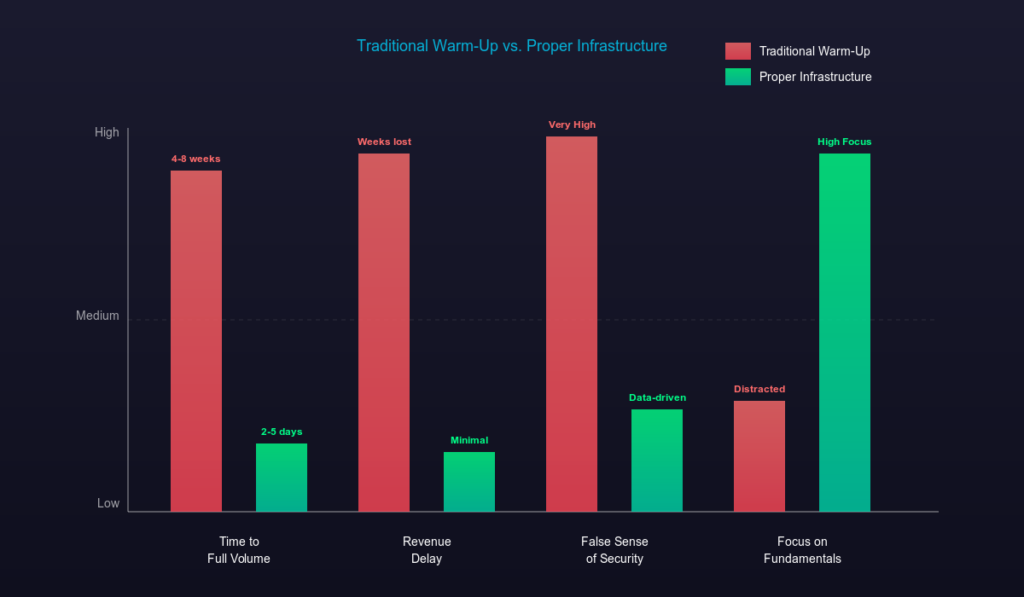
Beyond being ineffective, the warm-up obsession carries real costs. It delays revenue-generating campaigns while you’re stuck in your ramp period. It creates a false sense of security, leading senders to believe that deliverability is about patience rather than fundamentals. And it diverts attention and resources away from the harder work of building a genuinely engaged audience.
Perhaps most perniciously, it perpetuates the idea that deliverability is a technical hack rather than a reflection of whether you’re providing value to recipients. You can’t trick Gmail into thinking your emails are wanted if they’re not. You can only actually send wanted emails.
A Better Approach: Infrastructure That Actually Works
An enterprise-grade email platform like Hotsol fundamentally changes the equation. We solve the infrastructure problem that individual warm-up attempts fail to address. Rather than building reputation from scratch our pre-warmed server networks has established sending histories across a vast dedicated architecture. The reputation isn’t something you’re building gradually, it’s something you’re immediately accessing. When you send cold email campaigns through our platform, you’re not an unknown entity trying to prove yourself. You’re routing through infrastructure that Gmail, Microsoft, and Yahoo already recognize and monitor.
For cold email at scale, which faces inherently higher scrutiny than permission-based marketing, this infrastructure advantage is critical. The platform handles the technical complexity: rotating IPs to distribute volume, managing feedback loops, monitoring blacklists, and maintaining authentication protocols across the entire network. When issues arise, experienced deliverability teams intervene immediately, something no individual sender managing their own warm-up could replicate.
Hotsol gives marketers the confidence to shift focus from “how slowly can I ramp up” to “how relevant is my outreach.” With established infrastructure handling the technical foundation, senders can reach full volume within days while maintaining high deliverability, but only if the fundamentals are sound. Send only to relevant prospects, segment your audience and craft personalized, valuable messages.
The Bottom Line
The warm-up myth persists because it offers comfort in an uncertain landscape. It provides a clear, actionable process in a domain that often feels opaque and arbitrary. But at scale, email deliverability is earned through value and relevance, combined with infrastructure that’s already proven itself to major email providers.If your emails aren’t landing, it’s not because you haven’t been patient enough, it’s because recipients don’t want what you’re sending.
For marketers serious about cold email outreach at scale, the choice is clear. Stop wasting weeks on theatrical warm-up schedules and start leveraging infrastructure that’s built for scale.
Bulk Email Plans for Cold Outreach
Scale your cold outreach without killing deliverability. Start generating predictable growth for your business.
Starter.
$199.99
BILLED MONTHLY
-
250K Emails Monthly Unlimited Contacts
2 Custom Domains
2 Mailboxes
SMTP/API
24/7 Email & Chat Support SPF, DKIM & DMARC
No Set-up Fees
Pro.
$299.99
BILLED MONTHLY
-
500K Email Monthly
Unlimited Contacts
4 Custom Domains
4 Mailboxes
SMTP/API
24/7 Email & Chat Support SPF, DKIM & DMARC
No Set-up Fees
Premier.
$449.99
BILLED MONTHLY
-
1MM Emails Monthly Unlimited Contacts
6 Custom Domains
6 Mailboxes
SMTP/API
24/7 Email & Chat Support SPF, DKIM & DMARC
No Set-up Fees
Elite.
$899.99
BILLED MONTHLY
-
2.5MM Emails Monthly Unlimited Contacts
8 Custom Domains
8 Mailboxes
SMTP/API
Phone & Priority Support
SPF, DKIM & DMARC
No Set-up Fees