


High volume email sending with Gmail and Yahoo.
If your open rates have quietly collapsed, or your campaigns have started throwing bounce errors overnight, you’re not imagining it. Gmail and Yahoo have spent the last two years turning “best practice” email rules into hard, enforced walls — and by 2026, those walls are no longer forgiving.
For most cold email teams, this shows up as one of three symptoms: messages stuck in deferral, entire domains suddenly rejected outright, or campaigns that used to land in the inbox now vanishing into spam. None of that is random. It’s the direct result of policy changes that specifically target the way most cold email tools try to scale — by cramming volume through dozens of rotated personal-style inboxes.
What Actually Changed at Gmail and Yahoo
In October 2023, Google and Yahoo jointly announced a new set of requirements for anyone sending bulk email. Enforcement began in February 2024, and by November 2025 it had escalated from soft warnings into permanent rejections at the SMTP level — meaning non-compliant mail doesn’t just land in spam, it bounces before it ever reaches an inbox.
The chart below shows how quickly that enforcement tightened.
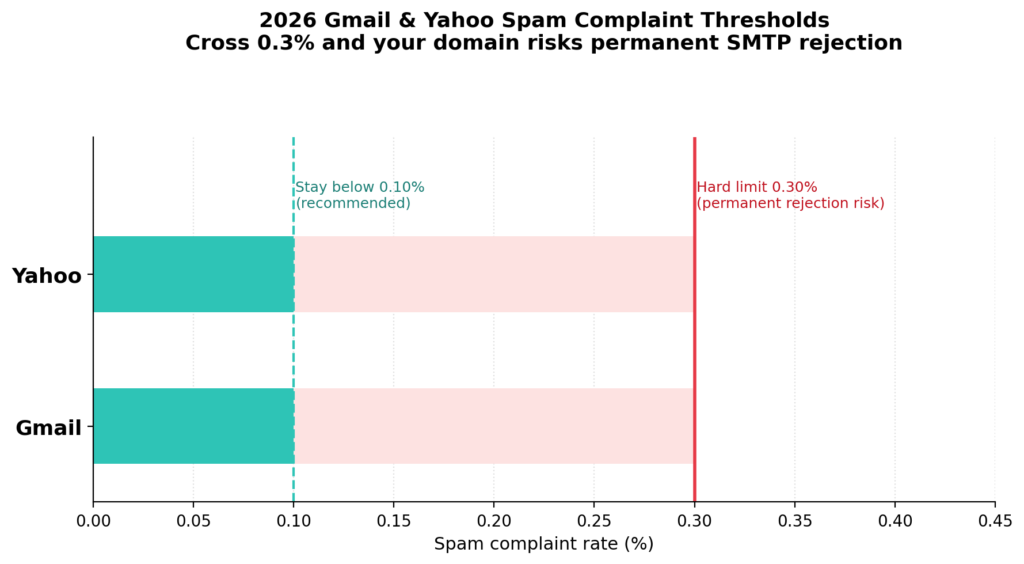
The core rules haven’t changed much since they were introduced, but the tolerance for getting them wrong has disappeared entirely. Here’s what’s now required of any domain sending 5,000+ emails a day to Gmail or Yahoo addresses:
- SPF and DKIM authentication, with DMARC alignment on top of both
- A published DMARC record, ideally moving toward enforcement rather than sitting at
p=none - Valid forward and reverse DNS (PTR) records on every sending IP
- One-click unsubscribe via the
List-UnsubscribeandList-Unsubscribe-Postheaders (RFC 8058), honored within two days - A spam complaint rate that never approaches 0.3% — and realistically should stay under 0.1%
That last point is the one that quietly kills the most cold email campaigns. It only takes 30 spam reports out of 10,000 sends to hit the 0.3% ceiling, and cold outreach — by nature, unsolicited — routinely runs 0.5–1% without careful targeting and list hygiene. Cross that threshold once, and Gmail can classify your domain as non-compliant going forward, even if you clean things up later.
Why "Mailbox-Stacking" Platforms Are Running Out of Road
Most cold email tools on the market — the ones built around connecting dozens of Gmail, Outlook, or Google Workspace inboxes and rotating sends across them — were designed for a world where 5,000 emails per inbox per day was a soft, generous ceiling. That world doesn’t exist anymore.
Once a domain crosses the bulk sender threshold, Google treats the classification as permanent. Rotating sends across 50–100 stacked mailboxes doesn’t get you out of that classification — it just delays the moment one of those inboxes trips a spam filter and drags the reputation of every other mailbox on the same domain down with it. It also means you’re managing dozens of individual inbox warmups, individual authentication setups, and individual points of failure, any one of which can take the rest of the stack down.
Hotsol was built around a different premise: instead of stacking consumer-style mailboxes and hoping the rotation holds, sends run through dedicated, purpose-built infrastructure designed to meet the 2026 compliance bar as a baseline, not an afterthought.
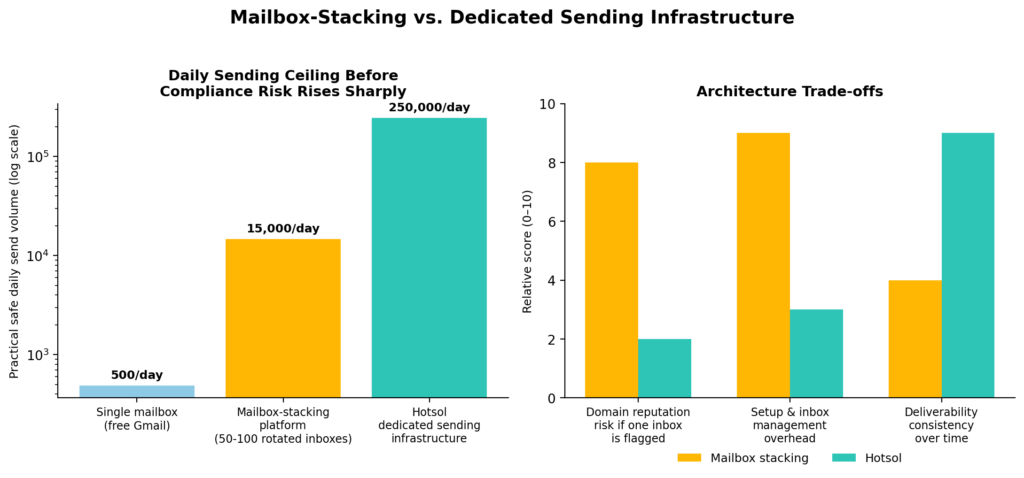
The difference isn’t cosmetic. A flagged mailbox inside a stacked-inbox tool damages the shared domain reputation everyone else on that account is riding on. A flagged sending path inside Hotsol’s infrastructure is isolated, monitored, and remediated without putting the rest of your volume at risk.
How Hotsol Keeps You Compliant at Scale
Sending millions of emails safely isn’t about finding a workaround for Gmail and Yahoo’s rules — it’s about being unambiguously compliant with them at a volume most tools were never built to handle cleanly. Hotsol’s approach covers the requirements end to end:
Authentication handled at the infrastructure level. SPF, DKIM, and DMARC alignment are configured and monitored as part of the sending architecture itself, not left for each user to bolt on domain by domain.
Built-in one-click unsubscribe. Every commercial send carries the RFC 8058 headers Gmail and Yahoo now require, so unsubscribes are honored automatically rather than becoming a compliance gap.
Spam-rate monitoring before it becomes a problem. Because sending is distributed across dedicated, properly warmed infrastructure rather than a handful of rotated personal inboxes, complaint rates stay well clear of the 0.3% line instead of hovering near it.
Reputation isolation. Problems on one sending path don’t cascade into every other campaign running on the platform — a structural advantage that mailbox-stacking tools can’t replicate, because their entire model depends on shared inbox pools.
Volume that scales without the fragility. Where a stacked-inbox setup starts breaking down past roughly 15,000 emails a day, Hotsol’s dedicated infrastructure is built to hold hundreds of thousands of compliant sends daily — without needing a growing pile of new inboxes to get ther
The Bottomline
Gmail and Yahoo aren’t going to loosen these rules — if anything, the trend from 2024 through 2026 has been steadily tighter enforcement, with Microsoft now following the same playbook for Outlook. Tools built around rotating personal-style inboxes were a reasonable answer in 2022. In 2026, they’re a liability sitting on borrowed time.
If your campaigns are hitting deferrals, bouncing outright, or quietly sliding into spam, the fix isn’t more inboxes — it’s infrastructure that was built for these rules from the start. Hotsol gives businesses the foundation needed to move beyond Gmail and Yahoo mailbox limitations and build scalable email marketing operations.
Managed SMTP Plans for every business
Powerful, reliable email delivery infrastructure designed for high-volume sending needs. Built for companies that require more control, scalability, and performance than traditional email providers.
M-SMTP 1
$400
BILLED MONTHLY
-
2 Sending Domains
2 Mailboxes - 250K Emails Monthly
- Daily Optimization
- 24/7 Email & Chat Support
- Domain Warm Up
- Blacklist Monitoring
- Feedback Loops
M-SMTP 2
$800
BILLED MONTHLY
- 4 Sending Domains
- 4 Mailboxes
- 500K Emails Monthly
- Daily Optimization
- 24/7 Email & Chat Support
- Domain Warm Up
- Blacklist Monitoring
- Feedback Loops
M-SMTP 3
$1,200
BILLED MONTHLY
- 8 Sending Domains
- 8 Mailboxes
- 1MM Emails Monthly
- Daily Optimization
- Phone & Priority Support
- Domain Warm Up
- Feedback Loops
- IP Blacklist Monitoring
- Deliverability Management
M-SMTP 4
$1,500
BILLED MONTHLY
- 12 Sending Domains
- 12 Mailboxes
- 1.5MM Emails Monthly
- Daily Optimization
- Phone & Priority Support
- Domain Warm Up
- Feedback Loops
- IP Blacklist Monitoring
- Deliverability Management